Begin with the human story
Meet the people, places, questions, and historical moments that gave each idea its shape.
Every investigation includes all three lenses; choose the one that helps you begin.Explore
Buddhist traditions examine experience, suffering, and freedom through teaching and practice. Modern science investigates the physical world through measurement, mathematics, and experiments others can repeat. Here, we compare them without pretending they use the same method.
An editorial promise
Comparison should deepen both sides of a question—not flatten them into the same answer.
Buddhist traditions and modern science emerged in different times, ask different kinds of questions, and use different standards of evidence. Explore preserves those differences while making room for thoughtful conversation.
Choose how you enter
Meet the people, places, questions, and historical moments that gave each idea its shape.
Every investigation includes all three lenses; choose the one that helps you begin.Investigation 01 · Ancient observations, modern echoes
Long before a telescope revealed another galaxy, Buddhist communities inherited stories of a cosmos too large to hold in a single sky. The scale is arresting. The meaning requires care.
Open the manuscriptA cinematic opening
In the discourse now catalogued as AN 3.80, Ānanda asks how far an awakened teacher’s voice might reach. The answer does not begin with a measurement. It unfolds a world picture.
One sun and moon become a thousand. That thousand becomes part of a larger thousandfold system. The scale opens again, and then again.
This is not a forgotten astronomy textbook waiting to be proven correct. It is an ancient Buddhist cosmology preserved inside a religious discourse—with mountains, continents, oceans, divine realms, and claims no telescope is designed to test.
The structure, simply
Choose a layer to see how the traditional grouping grows. The arithmetic below explains the textual structure; it does not turn the ancient model into modern astronomy.
AN 3.80 describes one thousand world systems, each presented with its own sun, moon, Mount Sineru, continents, oceans, and celestial realms.
Original source context
AN 3.80 is the catalogue name of a discourse in the Aṅguttara Nikāya, an early Buddhist collection arranged by number. In it, the monk Ānanda asks how far a Buddha’s voice might reach.
The answer describes suns and moons, but also Mount Sineru—a sacred mountain in ancient Indian cosmology—four continents, oceans, divine realms, and worlds associated with the deity Brahmā. Keeping those unfamiliar features prevents us from selecting only details that resemble modern astronomy.
Later translations sometimes call the three-tier system a trichiliocosm, literally a threefold thousand-world structure. Translation vocabulary varies. A modern word such as “galaxy” can help a reader picture scale, but it is not proof that an ancient author possessed the modern scientific concept.
Two pictures of a large cosmos
The Buddhist description organizes worlds with suns, moons, sacred geography, continents, oceans, heavens, and beings. It belongs to an ancient Indian religious and cosmological setting.
Modern astronomy describes planets, stars, galaxies, clusters, and the cosmic web using telescopes, spectra, mathematics, physical theory, and observations that can be checked by others.
Both pictures refuse to treat the visible human world as the whole cosmos. Both invite the imagination beyond one sun, one moon, and one familiar horizon.
The Buddhist scheme is a traditional cosmology embedded in a discourse about awakened power. Modern cosmic structures are evidence-based physical classifications. Their units, methods, geography, and explanatory goals are not equivalent.
A boundary worth protecting
Evidence & confidence
The nested world-system description is directly present in AN 3.80 and appears across Buddhist translation traditions.
Modern evidence strongly supports a universe containing many stars, galaxies, groups, clusters, and larger structures.
Both present a cosmos larger than one visible world, but their categories and purposes differ substantially.
No verified source establishes that the traditional system is the same model as modern astronomy.
A changing human view
AN 3.80 records a nested world-system scheme in a discourse about how far a Buddha’s voice could be made known.
NASA’s historical timeline records Galileo’s telescopic observations of Jupiter’s moons, Venus, and sunspots.
NASA’s account of Edwin Hubble describes his evidence that Andromeda lies beyond the Milky Way and his later work on an expanding universe.
NASA released Webb’s first full-color science images, extending infrared observation of distant cosmic history.
Modern astronomy studies galaxies, groups, clusters, superclusters, voids, and the cosmic web through observation, physical theory, and revision.
Reflection
Practice · Look beyond one sky
Tonight, find one visible point of light. Pause before naming it. Imagine the many scales between your eye and the larger structures studied by astronomy. Then write two sentences: one about what you observed, and one about what you imagined. Keep them separate.
Save a private reflectionCommunity discussion
Can an ancient cosmology remain philosophically meaningful when its physical picture differs from modern science? What would respectful comparison require?
Discuss with careInvestigation 02 · Ancient observations, modern echoes
A bowl can look perfectly still. A monastic rule asks us to pause before assuming that nothing lives within it. Modern biology opens a different window—and demands a careful comparison.
Look more closelyThe story
Imagine a monk preparing to drink after a long walk. The water before him is clear, but the Vinaya—the Buddhist monastic discipline—does not let appearance settle the matter.
Its rules show concern for living beings in water, and its practical allowances include strainers. The moral question is immediate: if life is present, how can ordinary need be met without careless harm?
That concern belongs to monastic ethics. It does not require a theory of cells, bacteria, or infection. The ancient text asks how to act; modern microbiology asks what is present, how it lives, and how we can detect it.
Interactive magnification
Select a magnification. The field is a conceptual illustration, not microscope data and not a prediction about any particular glass of water.
Color and cloudiness can be visible. Microorganisms usually cannot be identified by unaided sight.
What the Buddhist sources say
The Vinaya—the collection of rules and guidance for Buddhist monastic life—addresses water known to contain living beings. A section called the Cullavagga permits several kinds of strainer and expects a traveling monk to have access to one.
Later monastic explanations describe a practical ethical concern: make water usable while avoiding harm to small beings that can be noticed in it.
The ancient category is “living beings,” not “microorganisms” in the modern biological sense. Some traditional explanations discuss creatures visible to the eye. Reading “bacteria” back into the wording would exceed the evidence.
Source trail: Pārivāra 1.1 for the canonical summary; Cullavagga V.13 and the cited Buddhist Monastic Code for strainers and later monastic explanation.What modern science says
Depending on its source, water may contain bacteria; protozoa, which are tiny single-celled organisms; algae; fungi; or other biological material. Viruses may also be present. Viruses are not cells and are usually too small for an ordinary light microscope.
Microorganisms—living things too small to see unaided—are diverse. Some are harmless, some help ecosystems, and some are pathogens, meaning they can cause disease. Appearance alone cannot identify which are present.
Public-health systems may filter particles, disinfect water to control harmful organisms, test it regularly, and protect its source. An ancient cloth strainer is not equivalent to modern drinking-water treatment.
Comparison
The monastic practice refuses to assume that clear water is lifeless. Microbiology likewise shows that visual clarity alone does not establish biological absence.
Vinaya rules guide conduct toward beings understood to be in water. Modern microbiology identifies organisms through instruments, classification, culture, molecular tests, and reproducible investigation.
Misconceptions
Evidence & confidence
Canonical and monastic sources directly address water containing living beings and water strainers.
Modern public-health sources establish that untreated or contaminated water can contain microorganisms and pathogens.
Both challenge confidence in unaided appearance, but they do so with different aims and concepts.
The sources do not describe bacteria through modern biology or demonstrate microbial discovery.
Reflection
Practice · Separate seeing from inference
Place a clear glass of safe drinking water in light. Write three lines: what you directly see, what you infer, and what would require a test. Do not collect or drink untreated water for this exercise.
Save a private reflectionCommunity discussion
How can an ancient ethical practice remain meaningful without turning it into a modern scientific discovery claim?
Discuss with careInvestigation 03 · Ancient observations, modern echoes
A star gathers from darkness. It burns, changes, and ends. Its material may enter new worlds. Much later, on one such world, a leaf opens—and a person raises a hand made from ancient elements toward the night.
Follow the changeA story without a still frame
Before it shone, it was a gathering cloud. During its life, its temperature, brightness, fuel, and balance changed. Its ending did not erase every part of its story.
Elements made or dispersed by generations of stars became ingredients in later cosmic structures. Some entered planets. On Earth, elements move through air, stone, water, cells, trees, and bodies. The path is branching, not a single chain guaranteed to lead from one star to one person.
Buddhist teaching begins closer to home: this body changes; pleasant feeling changes; grief changes; every experience assembled from conditions changes. Anicca is not merely a fact to memorize. It is something to notice before we demand that a changing thing remain.
What is Anicca?
Anicca is commonly translated as impermanence or inconstancy. Conditioned experiences arise because supporting conditions come together. When those conditions shift, the experience cannot stay exactly as it was.
Early Buddhist teachings apply this observation to the parts of lived experience: body, feeling, perception, mental activities, and consciousness. The practical question is not whether change exists, but what happens when we cling to what cannot remain under our control.
The Buddha taught impermanence as a way of seeing more clearly. When changing experience is treated as permanently “mine,” its movement brings friction and distress. Seeing it accurately can loosen grasping; it is not a command to become cold, passive, or indifferent.
Animated lifecycle
Choose a stage. This simplified illustration shows broad stellar pathways; a star’s actual evolution depends strongly on its mass and composition.
Gravity draws gas and dust together. A protostar takes shape inside a cloud.
Modern science
Science investigates different kinds of change through different methods, timescales, and evidence.
Stars form, spend long periods fusing light elements into heavier ones, and meet different endings depending largely on their mass.
Cells grow, divide, take on specialized jobs, respond to stress, grow old, or die. Scientists call a cell that has stopped dividing but remains active senescent.
Aging is not one clock. It emerges from changes in cells, tissues, organs, repair systems, behavior, and environment.
Climate changes naturally over long periods. Measurements show that today’s rapid warming is driven mainly by greenhouse gases released through human activity.
Populations change across generations. Mutations introduce genetic differences; natural selection favors some inherited traits; chance can shift traits in small populations; and migration carries genes between populations.
Similarity and difference
A star, body, forest, or mood may seem steady at one timescale while processes continue within it. Both perspectives challenge the intuition that familiar things are fixed.
Science investigates how physical and biological systems change and tests explanations against evidence. Buddhist practice studies the distress that arises when changing experience is grasped as permanent, controllable, or self.
Reflection journal
Write privately. Your entry stays in this browser and is not shared with the community.
Practice · Five changing things
Name only what you observe. Notice any wish for the pleasant to stay or the unpleasant to disappear.
Continue in PracticeCommunity discussion
Share an experience without turning another person’s loss into a lesson for them. Reflection deserves gentleness as well as honesty.
Discuss with careInvestigation 04 · Ancient observations, modern echoes
A seed waits in dark soil. Rain arrives. Fungi trade nutrients at its roots. Light reaches a new leaf. No single condition is the forest—and without conditions, there is no tree standing by itself.
Trace the conditionsA morning in the forest
Ask where the tree began and the answer keeps moving. The seed came from another tree. That tree depended on soil built by older life. Water arrived through weather. Its carbon came from the air; its energy from sunlight.
Yet dependent origination is more precise than this forest story. The Buddhist teaching does not merely announce that everything touches everything. It examines particular conditions through which suffering arises—and the conditions through which it can cease.
The forest, economy, climate, family, and emotion examples below are analogies. They can train our attention to relationships, but they are not substitutes for the canonical sequence.
The conditional formula
“When this exists,that comes to be.
With the arising of this,that arises.”SN 12.37, translated by Bhikkhu Bodhi
This formula describes conditionality: something happens because the conditions it needs are present. Think of a flame: it depends on fuel, oxygen, and heat, not on one isolated cause. The teaching does not claim that every event directly causes every other event.
The reverse matters just as much. Remove a condition the process truly needs—like fuel from the flame—and what depends on it cannot continue in the same way. This is why the teaching is practical: it asks which conditions can be understood and changed.
What it actually means
The teaching attends to patterned dependence. Traditions interpret the links across moments, lifetimes, and psychological processes, so one diagram should not pretend to settle every interpretation.
Its liberating force lies in reversibility: when ignorance, craving, and grasping are no longer fed, the processes depending on them can change and cease.
Interactive network
This model is educational, not predictive. Real systems have more conditions, feedback loops, delays, thresholds, and unknowns than six nodes can show.
A forest emerges from relationships among living and nonliving conditions. Remove one and the others do not simply disappear—they respond.
Five everyday lenses
A forest emerges from relationships among living and nonliving conditions. Remove one and the others do not simply disappear—they respond.
Prices and livelihoods arise through institutions, labor, resources, trust, transport, policy, and countless decisions.
Climate patterns arise through interacting oceans, atmosphere, land, ice, life, and energy from the sun.
A family moment is shaped by histories, needs, habits, care, communication, and pressures outside the home.
An emotion may depend on body state, memory, interpretation, attention, surroundings, and what just happened.
Modern science
Systems thinking asks how parts change one another inside a larger whole. Network science draws those parts as points and their relationships as links. Ecology studies organisms together with soil, water, climate, and other surroundings.
Complex-systems research studies effects that appear only when many parts interact. Emergence is a group pattern no single part produces alone, like traffic forming from many drivers. Feedback means an effect circles back to strengthen or weaken its cause. Nonlinearity means twice the input may produce much more—or much less—than twice the result.
Scientists test these ideas with mathematical models, observations, experiments, and simulations. The resemblance to conditionality can be useful, but these fields do not contain the Buddhist account of craving, grasping, suffering, or freedom from suffering.
A crucial boundary
Quantum entanglement is a specific physical relationship between quantum systems, described mathematically and tested experimentally. It is not a scientific name for social connection, ecological dependence, emotion, karma, or universal oneness.
Dependent origination is a Buddhist teaching about conditioned arising and cessation, especially the arising and ending of suffering. Similar words such as “relation” or “dependence” do not make the two concepts equivalent.
Reflection · Trace an emotion
What sensations, energy, hunger, pain, or fatigue were present?
What happened immediately before the emotion appeared?
What meaning did your mind give that event?
What memory, habit, or earlier experience shaped the response?
Who, what, and which pressures were around you?
Practice · Pause at one link
When a strong feeling appears, name the contact, the feeling tone, and the first sign of wanting or resistance. Ask which condition can be met with more care.
Continue in PracticeCommunity discussion
Which condition in your life has changed a whole system—family, work, community, or inner life—in a way you did not expect?
Discuss with careQuantum Dialogue · Investigation 01
Two particles leave one source in opposite directions. Far apart, they are measured. Across many trials, their results fit together more strongly than a certain classical picture allows. The resemblance to interdependence is evocative. It is also easy to misuse.
Begin without equationsBegin with the experiment
A laboratory prepares pairs of photons—small packets of light—in an entangled state. “Entangled” means quantum theory must describe the pair with one shared mathematical state, even after the photons travel apart. One photon goes to Alice’s detector; the other goes to Bob’s. Each detector can be turned to test polarization, the orientation in which light oscillates.
A single result looks random. The pattern appears only after Alice and Bob compare many recorded trials through ordinary communication. Quantum mechanics predicts correlations: statistical relationships between their lists of results.
Entanglement is not an invisible message passing between minds or particles. The “joint state” is the mathematical description of the pair as a whole. Its predictions are tested by preparing and measuring many pairs in the same way.
Interactive concept model
This animation illustrates correlated outcomes. It is not a Bell experiment, a simulation of quantum probabilities, or live laboratory data.
Choose a basis, then reveal one illustrative correlated outcome.
Einstein, Bell, and experiment
They argued that quantum mechanics might be incomplete. Perhaps, they suggested, separated particles carried definite properties that the theory had not described.
Bell found a numerical boundary, now expressed through Bell inequalities. A broad family of theories based on pre-existing local instructions must stay within that boundary; quantum mechanics predicts that suitable experiments can cross it.
Repeatedly improved experiments crossed Bell’s boundary as quantum mechanics predicted. Later experiments closed important “loopholes”—alternative explanations caused by weaknesses in an experimental setup.
Alain Aspect, John F. Clauser, and Anton Zeilinger received the prize for experiments with entangled photons, Bell-inequality violations, and quantum information science.
Bell experiments, in plain language
Imagine each particle leaves the source with a private instruction sheet containing its answer for every detector setting. Also assume that nothing at Alice’s detector can instantly change Bob’s distant result. Bell showed that theories built from both ideas cannot produce correlations beyond a particular numerical limit.
Experiments cross that limit. Physicists call the rejected family “local hidden-variable” theories: hidden variables are the imagined instruction sheets, while local means distant events cannot influence one another faster than light. The experiments do not select one universally accepted interpretation of quantum mechanics.
The Buddhist side
The early Buddhist formula says that when a relevant condition exists, a dependent process can arise; with the arising of that condition, the process arises. Its reverse describes cessation.
In its canonical setting, the teaching analyzes the arising of suffering through specific links—such as contact, feeling, craving, and grasping—and the possibility of release when those supports cease.
It is not a claim about photon polarization, spatial distance, Bell inequalities, or quantum information. “Interdependence” can be a helpful broad translation in some contexts, but it must not erase the teaching’s precise concern with conditions and suffering.
Interactive comparison
Both challenge a picture made only of isolated, independently describable things. Each gives relationships an important role. This resemblance can begin a thoughtful conversation, but it does not establish identity or scientific proof.
Misconception cards
Bell correlations do not establish telepathy, prayer transmission, or communication between souls.
Entanglement cannot be controlled to send usable information faster than light.
Standard Bell experiments do not require human consciousness to create or transmit their correlations.
Entanglement is not evidence that all people and objects share a single spiritual energy field.
Reflection
Before answering, ask what kind of relationship you mean: causal, statistical, social, historical, biological, or contemplative.
Practice · Observe one relationship
Choose one relationship in your life. Notice what conditions sustain it: time, attention, trust, shared history, boundaries, repair. Change one condition gently and observe what follows.
Continue in PracticeCommunity discussion
What becomes clearer when we compare ideas without insisting that they are the same?
Discuss with careQuantum Dialogue · Investigation 02
A musician touches one string. Two waves travel, overlap, and reshape the sound. Quantum superposition also uses a language of combination and interference—but it is a precise mathematical structure, not a metaphor for holding two opinions.
Follow the possibilitiesA story before equations
Imagine a carefully prepared quantum system with two possible measurement results. Before measurement, quantum theory represents its state as a superposition of the alternatives.
This does not mean a tiny ordinary object is secretly sitting in two familiar boxes in the everyday sense. Nor does it mean scientists simply lack information about a result already decided. The alternatives have amplitudes and phases that can interfere—a behavior ordinary uncertainty cannot reproduce.
When an apparatus performs a measurement, one result is recorded in that trial. Prepare and measure the system many times, and a probability pattern emerges.
The wave function
The wave function is a mathematical description of a quantum state. Think of it as a prediction tool: it assigns an amplitude to each result an experiment could record.
An amplitude is not an ordinary probability. It carries a size and a phase. Like waves arriving in step or out of step, amplitudes can reinforce or cancel through interference. Physicists calculate outcome probabilities from these amplitudes.
Physicists disagree about what the wave function ultimately says about reality. They agree on the mathematical rules used to make predictions that experiments can test.
Interactive animation
This is a conceptual sequence, not a numerical quantum simulation. The alternating demonstration outcomes are not generated with quantum randomness.
A wave function is a mathematical object used to represent a quantum state and predict measurement probabilities.
A probability claim is tested across repeated preparations and measurements, not established by one dramatic result.
Alternative amplitudes can combine constructively or destructively. This is why a quantum state is not merely a hidden classical coin toss.
The chosen measurement basis determines which set of possible outcomes the experiment asks about. “Observation” means a physical measurement process, not necessarily a conscious person watching.
The Buddhist side
Different Buddhist traditions use non-dual language differently. In SN 12.15, an early discourse avoids the fixed extremes “everything exists” and “nothing exists,” teaching conditioned arising as a middle. This is not the claim that both extremes exist simultaneously.
Later Mahāyāna traditions use teachings on emptiness to challenge rigid separation between categories such as form and emptiness. The Heart Sūtra is a famous example. Its purpose concerns wisdom, attachment, and liberation—not laboratory predictions.
Contemplative non-duality can question the habitual division of experience into a permanent observer standing apart from an observed world. That inquiry belongs to philosophy and practice. It is not a wave function.
Interactive comparison
A linear mathematical combination of quantum states, with amplitudes and phases that determine interference and measurement probabilities.
A family of philosophical and contemplative approaches that question rigid oppositions, intrinsic separation, or fixed conceptual extremes.
Misconceptions
A superposition is defined relative to a quantum state space and measurement basis, not an unrestricted catalogue of every imaginable event.
Quantum amplitudes carry phase and interfere. A classical unknown outcome does not generally behave this way.
Quantum measurement does not establish that human awareness selects the universe or controls arbitrary outcomes.
Resonant language does not supply the mathematics, apparatus, or experimental evidence of quantum mechanics.
Reflection
Consider a distinction you need—and one you may be treating as absolute.
Practice · Notice before naming
Listen to a sound for one minute. Notice the raw changing experience, then the labels the mind adds: pleasant, distant, mine, interruption. The exercise explores perception, not quantum physics.
Continue in PracticeCommunity discussion
Can two ideas illuminate one another while remaining fundamentally different?
Discuss with careQuantum Dialogue · Investigation 03
A bowl is empty of water but full of air, history, clay, labor, and use. A laboratory vacuum is empty of ordinary particles by a chosen definition, yet remains a physical state. The shared word “empty” conceals two very different teachings.
Begin with the bowlA story of an ordinary cup
A potter places a cup on the table. We call it one thing. Look closer and the unity loosens: clay, heat, hands, transport, language, expectation, and a purpose supplied by the person who reaches for it.
If the handle breaks, is it still the same cup? If the clay is ground down and shaped again, where did the cup go? Emptiness asks us to inspect the independent essence we assumed was hiding inside.
The answer is not that the cup does not exist. It holds tea, can be repaired, and can cut a hand when broken. It exists conventionally through parts, conditions, designation, and use—without possessing a permanent, self-established “cup nature.”
What Śūnyatā teaches
Śūnyatā, usually translated as emptiness, is developed in multiple Buddhist traditions with different vocabularies and arguments. In Mahāyāna philosophy, phenomena are empty of an inherent nature that establishes itself independently.
Things still function. Causes have consequences. People experience pain and care. Conventional distinctions remain usable. Emptiness challenges the belief that these changing, conditioned realities possess a fixed core existing from their own side.
Dependent existence and emptiness therefore support one another: because a phenomenon arises through conditions, it is empty of isolated self-existence; because it is not frozen by an intrinsic essence, it can arise, change, relate, and cease.
Conceptual diagram 01
Removing a condition changes what the cup can be, how it appears, or whether the category applies. The diagram is a teaching aid, not a complete philosophical proof.
What physics means by vacuum
In quantum field theory, particles are understood as excitations of fields. The vacuum is the ground state: the state with the lowest available energy for the theory or system under consideration.
“Lowest” does not automatically mean zero. A field can have nonzero vacuum values, correlations, and fluctuations, and vacuum structure can affect measurable phenomena. The exact description depends on the theory, observer, boundaries, and physical setting.
Popular accounts often picture virtual particles literally appearing and disappearing. Virtual particles are primarily elements in perturbative calculations, not tiny objects directly photographed inside empty space. The underlying vacuum effects are physical; the cartoon should not replace the formalism.
Conceptual diagram 02
Ground-state fluctuations and correlations belong to a mathematical physical theory. This wave is conceptual artwork, not measured vacuum data.
Interactive comparison
A philosophical and contemplative analysis of how phenomena exist dependently, conventionally, and without self-established essence.
The boundary cannot be optional
The quantum vacuum is not the Buddhist meaning of emptiness made measurable. It is a particular state defined within quantum field theory.
Śūnyatā is not a hidden substance, cosmic field, reservoir of energy, or physical space from which particles emerge. It is not located between atoms.
Vacuum experiments cannot prove Buddhist liberation, and meditation does not manipulate vacuum energy. Similar English words do not establish scientific equivalence.
Four corrections
Buddhist analysis preserves conventional functioning and consequences while denying independent intrinsic essence.
Physics defines it as a physical ground state with theory-dependent structure and properties.
Śūnyatā is not matter, energy, space, or a field. The quantum vacuum is not a contemplative realization.
A physical result does not establish that a Buddhist philosophical term predicted quantum field theory.
Reflection
Choose one ordinary thing. Trace its parts, causes, name, users, and setting. What remains when you stop searching for an isolated essence?
Practice · Hold without freezing
Notice one label you use today—success, failure, stranger, self. Ask which conditions make the label useful and where treating it as permanent causes harm.
Continue in PracticeCommunity discussion
How can emptiness support responsibility rather than weaken it?
Discuss with careEditorial narratives
Personal journeys, historical moments and inspiring discoveries.
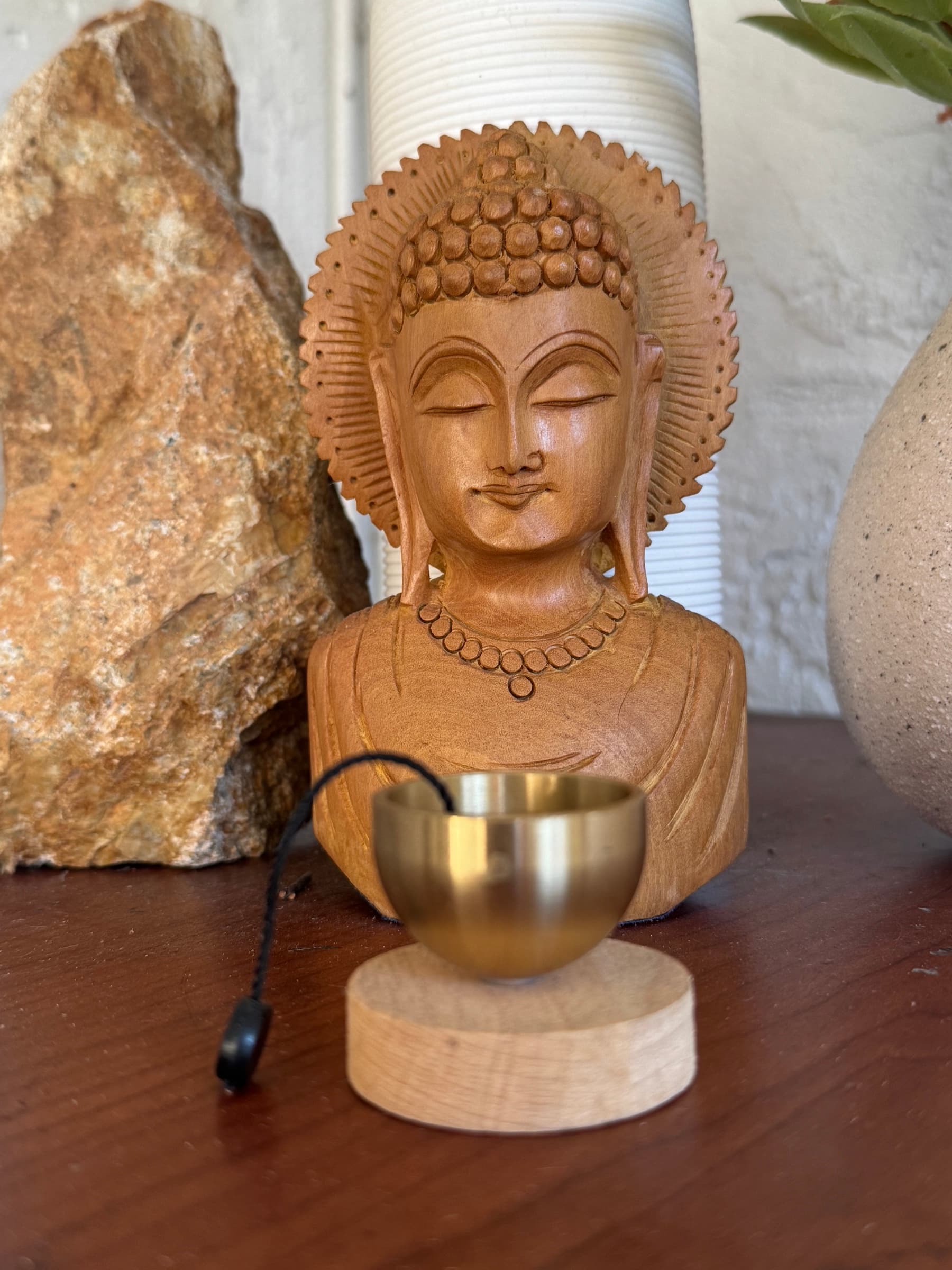
A story about conflict, generosity, and the quiet arrival of unexpected conditions

What changed was not the road I walked, but the mind that was walking through it.
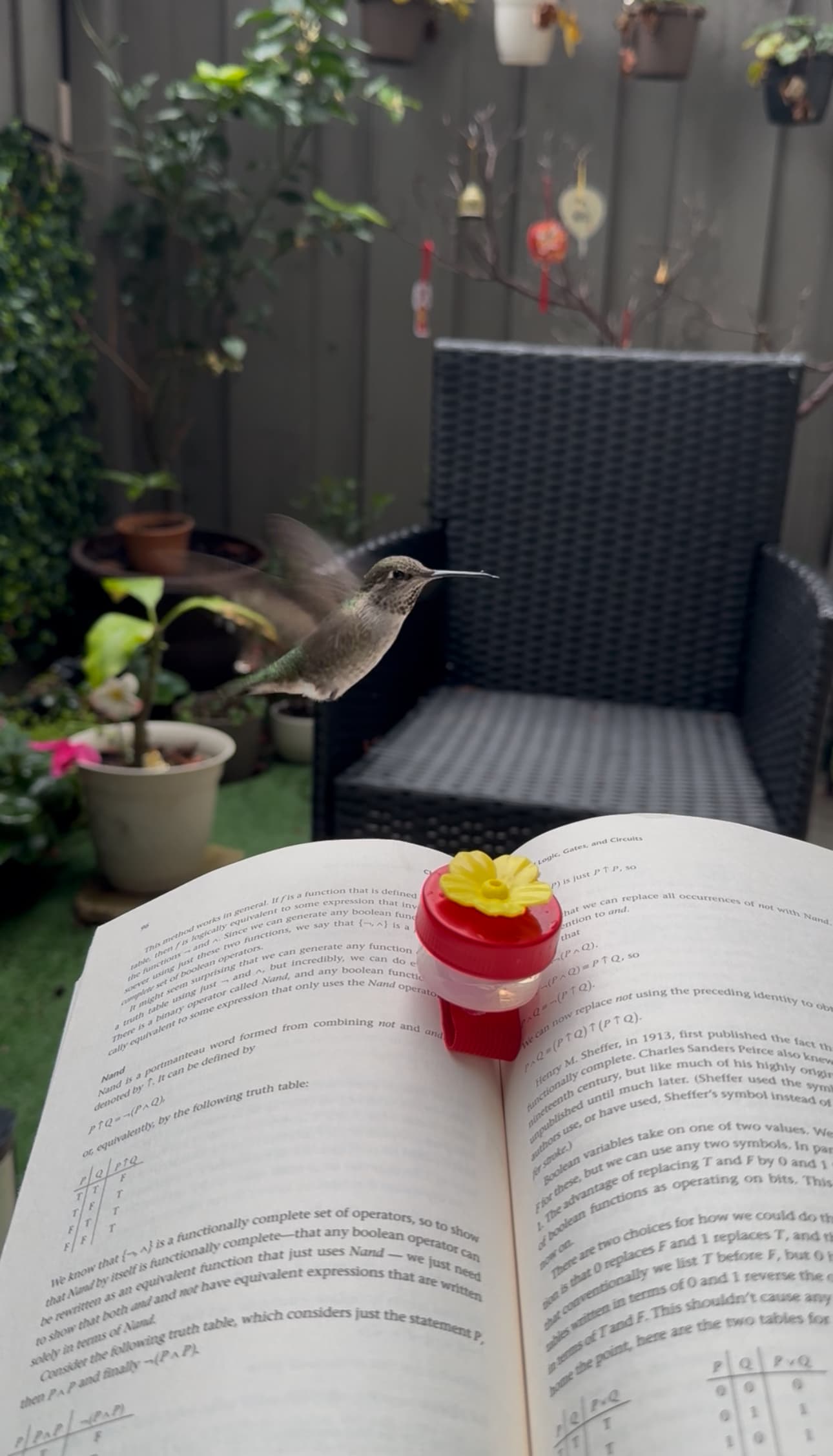
A difficult garden, a tiny hummingbird, and a quiet lesson about changing how we meet the world instead of trying to control it.

Some symbols stay with us long before we understand them.
A small everyday ritual becomes an invitation to notice relationship, change, and attention.
A physicist and a philosopher meet in sustained dialogue without requiring their disciplines to become the same.
How a famous disagreement about quantum theory became one of physics' most revealing experimental stories.
Questions about information, intelligence, and mind opened a quieter path back toward familiar teachings.
A childhood shaped by Buddhist traditions, a life in technology, and the questions that brought both worlds into conversation.
One twist of paper turns the ordinary distinction between two sides into a surprisingly difficult question.
Visual laboratory
Explore ideas with your eyes, your hands and your curiosity.
Compare measurement choices and explore the correlations tested in Bell experiments.
Move across scales and see how simple patterns can return in intricate forms.
Follow a single surface and test what you mean by inside, outside, and two.
Remove one condition and watch a simplified network reorganize around the change.
Adjust visual cues and notice how perception constructs more than the eye receives.
Change a probability wave and observe how its shape relates to possible outcomes.
Continue the inquiry
Use the learning paths to build the foundations behind these investigations, or bring a carefully framed question to the community.