Stories · Personal Story
The Lotus — A Flower of Compassion
Some symbols stay with us long before we understand them.
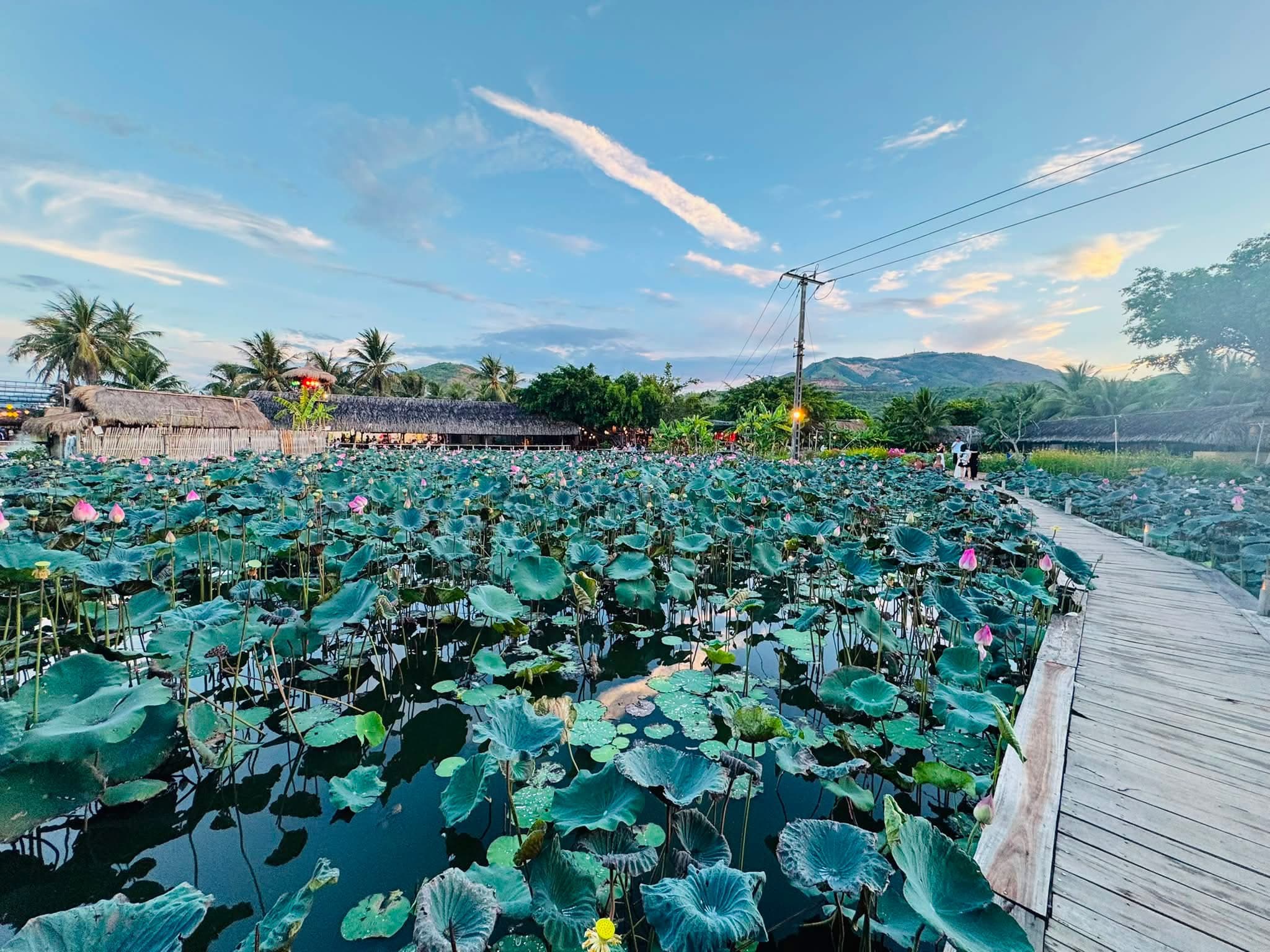
Some images enter our lives before we are old enough to understand why they matter.
I don't remember the first time I saw a lotus.
Perhaps that is because there was never a first time that mattered.
The lotus was simply there.
I grew up around Buddhism. My grandparents established a shrine dedicated to Quan Âm, and near it was a large lotus pond. The flowers bloomed there regularly, season after season, until the sight of them became part of the landscape of my childhood.
At that age, I did not know much about Buddhist philosophy.
I did not stand beside the pond thinking about compassion, karma, transformation, or enlightenment.
I simply knew the flowers.
Their broad leaves spread across the water. Their blossoms rose above the surface. At the center of the flower was the distinctive lotus pod, something I saw long before I understood why I would one day find it meaningful.
The pond was part of home.
Only many years later did I begin to realize that some of the things we understand most deeply do not begin as ideas.
They begin as memories.
As I grew older, one feature of the lotus began to fascinate me.
When the flower opens, the lotus pod is already there at its center. Within the beauty of the flower is already the structure from which the seeds will develop.
I began to think about this as an image of cause and effect.
Not as proof.
A flower cannot prove a Buddhist teaching, and botany does not demonstrate karma.
But an ordinary thing in nature can sometimes give the mind a way to approach an idea.
When I look at the lotus, I think about how what comes later is often connected to what is happening now.
A word we speak today may stay with someone longer than we imagine.
A small act of generosity may affect a person in ways we never see.
A habit repeated quietly can become part of who we are.
What we nourish grows.
What we neglect changes too.
In that sense, the flower and the seed remind me that the present is never completely isolated from what follows.
The future is not sitting fully formed inside the present. Life is far more complicated than that.
But what we do now becomes part of the conditions from which tomorrow emerges.
That is what the lotus came to mean to me.
There is another part of the lotus that is impossible to ignore.
It grows from mud.
We usually photograph the flower.
We admire the petals.
We notice how clean and delicate they appear above the water.
But beneath them is another world.
Mud.
Roots.
Dark water.
Conditions that are very different from the beauty we see at the surface.
For a long time, people have found meaning in that contrast. I understand why.
But I do not think suffering automatically makes someone wiser.
Hardship does not guarantee growth.
Pain can injure people. Difficult circumstances can leave wounds that deserve care rather than romantic interpretation.
The lesson I see in the lotus is more modest.
The mud is not the opposite of the flower. It is part of its story.
The lotus does not require a perfect world before it begins to grow.
That thought became more meaningful to me as I grew older.
Most of us do not get to choose perfect conditions for our lives.
There are disappointments.
There are mistakes.
There are things we cannot control.
There are moments when life looks very different from what we hoped it would be.
The lotus does not tell me that these things are good.
It reminds me that they do not necessarily have to determine everything that comes afterward.
Something beautiful can still grow in an imperfect place.
There is a third reason the lotus has always felt special to me.
It gives.
Many parts of the plant are useful to people.
The seeds can be eaten. The underground stems commonly called lotus roots are used in food. The leaves have practical and culinary uses. Across Asian cultures, the lotus has been part of ordinary life as well as religious imagery.
When I was young, I did not think of this as compassion.
I simply knew the lotus as something familiar.
But later, the idea began to stay with me.
The flower is beautiful, but its beauty is not the only thing it offers.
There is something beyond being admired.
There is usefulness.
There is giving.
And that is where, for me, the lotus became connected with compassion.
Compassion is often described as a feeling, but I have come to think that its deepest form has movement in it.
It becomes listening.
It becomes patience.
It becomes helping.
It becomes choosing not to make another person's burden heavier.
Sometimes it becomes something very ordinary: time, food, knowledge, protection, attention, or simply staying beside someone when there is nothing to fix.
A beautiful flower can attract our eyes.
A useful life can touch another life.
Perhaps that is why I think of the lotus as a flower of compassion.
Not because Buddhism has given me a rule that says I must call it that.
It is simply what the lotus has gradually come to represent for me.
Beauty that does not exist only for itself.
The older I become, the more I understand that the most important part of this story is not the symbolism.
It is the pond.
Before I understood karma, there was the pond.
Before I thought seriously about compassion, there was the pond.
Before I knew that the lotus carried centuries of Buddhist symbolism, there were flowers appearing near the Quan Âm shrine my grandparents had established.
The image came first.
Understanding came much later.
Perhaps this is why the lotus still feels different to me from symbols I discovered in books.
I did not first meet it as an idea.
I met it as part of childhood.
Years passed.
My life moved far beyond that pond.
I encountered technology, science, work, responsibility, questions about the world, and questions about myself.
Yet the lotus remained somewhere in the background of my mind.
And when I eventually began looking more carefully at Buddhism, I discovered that I was not meeting the lotus for the first time.
I was returning to something that had been waiting quietly in my memory.
Maybe that is how some forms of understanding arrive.
Not as revelation.
Not as a dramatic answer.
Sometimes life simply gives us enough years to look again at something we once took for granted.
And suddenly we see more.
### What This Memory Taught Me
I used to think understanding came from learning something new.
Now I think it can also come from returning to something old with different eyes.
The lotus pond did not teach me Buddhist philosophy when I was a child.
It gave me an image.
Only later did experience give me the language to reflect on that image.
The flower and seed made me think about consequences.
The mud made me think about conditions.
The usefulness of the plant made me think about compassion.
But perhaps the deepest lesson is simpler than all of those.
Some things remain with us because we are not finished understanding them.
### A Buddhist-Inspired Reflection
The lotus has an important place in Buddhist art and symbolism, but the reflections in this story are personal.
I see in the lotus an invitation to consider how we live among imperfect conditions without allowing those conditions to define everything we become.
I see a reminder that our actions have consequences beyond the moment in which we perform them.
And I see an image of compassion not merely as something beautiful to feel, but as something that becomes useful to another life.
These are reflections inspired by Buddhism, not quotations from scripture or claims about a single official meaning of the lotus.
### A Note on Symbol and Fact
The lotus is a biological organism.
Its flower structure, seed development, rhizomes, leaves, and ability to grow in aquatic environments can be studied scientifically.
Those botanical facts do not prove karma, compassion, enlightenment, or any Buddhist teaching.
The connections in this story are metaphors drawn from personal experience.
Science tells us how the lotus lives.
A human being may still look at that same lotus and ask what its life brings to mind.
Those are different kinds of questions.
They do not need to compete.
### A Question to Carry With You
Is there an image from your childhood that you only began to understand after you grew older?
Editorial reflections
Personal and editorial reflection—not canonical Buddhist teaching.
What this experience taught me
Some things remain with us because we are not finished understanding them.
A Buddhist reflection
These are reflections inspired by Buddhism, not quotations from scripture or claims about a single official meaning of the lotus.
Question for the reader
Is there an image from your childhood that you only began to understand after you grew older?
About this story
Personal experience · Photograph provided by the author