Stories · Personal Story
The Little Friend in the Garden
A difficult garden, a tiny hummingbird, and a quiet lesson about changing how we meet the world instead of trying to control it.
When we bought our home in 2021, I was already imagining the garden.
I pictured colorful flowers, healthy trees, and quiet mornings with coffee surrounded by birds. It was one of the reasons I loved the house before we even moved in.
Reality was different.
The backyard was covered with rocks hidden beneath a thin layer of soil. Tall trees beyond the fence blocked much of the sunlight throughout the day. Plants that seemed easy to grow elsewhere struggled here. Some never flowered. Others simply gave up.
At first, I approached the garden the way I had approached many other challenges in life.
Find the problem.
Research the solution.
Work harder.
Improve the result.
I bought different plants, experimented with soil, adjusted watering schedules, moved pots from one corner to another, and spent weekends trying to create the garden I had imagined.
Sometimes things improved.
Often they didn't.
Little by little, the garden began teaching me something I hadn't expected to learn.
Instead of asking, "How can I change this place?" I started asking, "What is this place trying to tell me?"
That small shift changed everything.
I stopped seeing the lack of sunlight as a problem to overcome and started paying attention to where the light naturally moved during the day.
I noticed which areas stayed damp after watering and which dried almost immediately.
I learned that some plants weren't failing because I wasn't trying hard enough. They simply belonged somewhere else.
The garden wasn't resisting me.
It was introducing itself.
As the months passed, my routines became quieter.
Sometimes I wasn't gardening at all.
I was simply sitting outside.
Listening.
Watching.
Learning the rhythms of a place that had existed long before I arrived.
That was when I began noticing a tiny visitor.
A hummingbird.
It never stayed long.
It would appear almost without warning, hover among the flowers for a few seconds, then disappear as quickly as it had come.
Every time I saw it, I smiled.
Eventually, a thought crossed my mind.
I wondered what it would be like if one day it trusted me enough to come closer.
Not because I wanted to touch it.
Not because I wanted a photograph.
Just because sharing that kind of quiet trust with a wild creature felt almost impossible—and therefore deeply beautiful.
Of course, I didn't expect it to happen.
Wild animals owe us nothing.
They don't exist to fulfill our hopes or reward our patience.
Still, without making a conscious decision, I found myself changing my own behavior.
When I noticed the hummingbird nearby, I stopped moving so quickly.
I stayed where I was.
I resisted the impulse to step closer.
I didn't follow it with my hands or my body.
I let the bird decide the distance between us.
Nothing dramatic happened.
Days became weeks.
Weeks became months.
The hummingbird continued living exactly as hummingbirds do.
Sometimes it appeared.
Sometimes it didn't.
Sometimes it stayed only a heartbeat.
But gradually, almost too gradually to notice at first, something felt different.
It no longer disappeared the instant it noticed me.
Occasionally it hovered nearby for another second.
Then another.
It wasn't becoming tame.
It was simply becoming less alarmed by my presence.
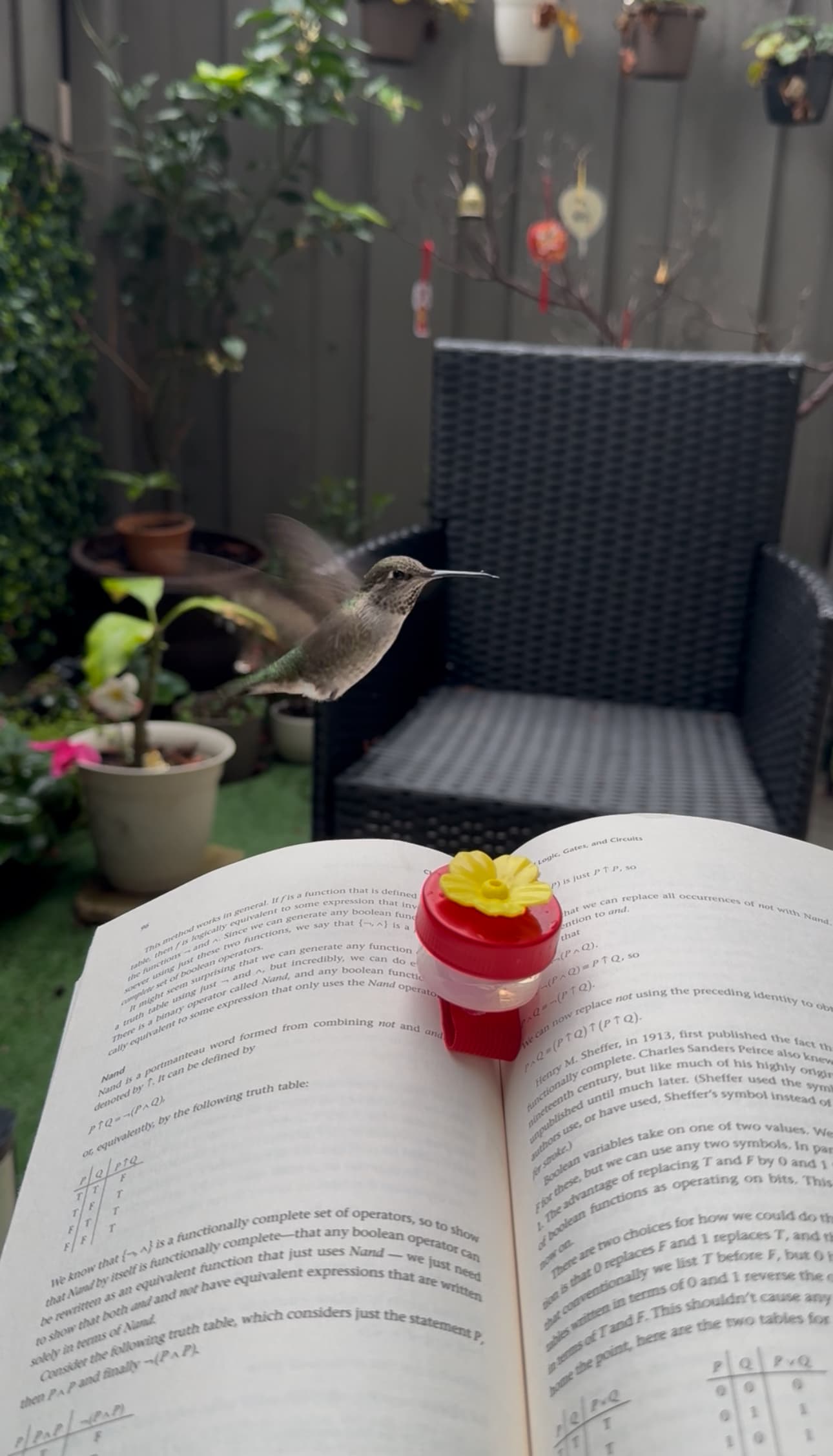
One afternoon, I was sitting outside reading a book about quantum physics.
Not because I expected physics to explain my garden.
I've always been fascinated by the questions modern physics asks about reality, uncertainty, and observation. Around the same time, I had also been reading Buddhist philosophy, appreciating how both traditions encourage careful observation—even though they ask very different questions and arrive through entirely different methods.
That afternoon, however, I wasn't thinking about philosophy.
I was simply reading.
Completely absorbed.
Then something caught the corner of my eye.
I looked up.
The hummingbird was hovering just in front of me.
Closer than it had ever come before.
For a brief moment, neither of us moved.
Then, just as quietly as it had arrived, it flew away into the garden.
Fortunately, I managed to capture the moment in a photograph.
Whenever I look at that picture now, I'm reminded of something important.
Not because it proves anything extraordinary.
Not because it confirms a spiritual belief.
Not because quantum physics somehow influenced a bird.
The photograph reminds me of how easily we confuse control with connection.
When I first arrived, I wanted to shape the garden into my own vision.
Over time, I became more interested in understanding the garden as it already was.
The same thing happened with the hummingbird.
I stopped hoping it would come closer.
I simply tried to become a quieter presence within its world.
Whether that changed the bird is impossible for me to know.
What I do know is that it changed me.
I became more patient.
More attentive.
More comfortable allowing things to unfold in their own time.
Looking back, I find quiet resonance with a Buddhist way of seeing the world.
Not because Buddhism explains hummingbird behavior.
It doesn't.
Wildlife follows its own instincts, shaped by biology and experience.
But Buddhist practice often invites us to loosen our grip on control, to meet each moment with greater presence, and to recognize that much of our suffering comes from insisting reality should be different from what it is.
The garden became a place where I could practice that—not through meditation alone, but through ordinary afternoons spent watching light, leaves, seasons, and a tiny bird that owed me nothing.
As for quantum physics, I think it deserves the same honesty.
Quantum mechanics is one of humanity's greatest scientific achievements, but it should not be used to explain every meaningful personal experience.
Nothing about this story suggests that consciousness influenced quantum events, that positive energy attracted the hummingbird, or that modern physics validates Buddhist teachings.
The bird came because it chose to come.
The garden grew according to its own conditions.
The only change I can speak about with certainty happened within me.
Perhaps that is enough.
Sometimes we spend years trying to change the world around us.
Sometimes the quieter transformation begins when we change the way we enter that world.
And every so often, if we are fortunate, a small friend reminds us that presence can deepen our relationship with life—not by making the world obey us, but by helping us finally notice the world that has been there all along.
So I wonder: if nothing around you changed tomorrow, but the way you met the world did, what might you begin to notice for the first time?
Editorial reflections
Personal and editorial reflection—not canonical Buddhist teaching.
What this experience taught me
The photograph reminds me of how easily we confuse control with connection.
A Buddhist reflection
Buddhist practice often invites us to loosen our grip on control and to meet each moment with greater presence.
Question for the reader
If nothing around you changed tomorrow, but the way you met the world did, what might you begin to notice for the first time?
About this story
Personal experience · Photograph provided by the author